In the high-stakes realm of contemporary pro-level sliding, victory is not merely exclusively a product of brute torque or behind-the-wheel bravado. Instead, it is now a multifaceted science that demands a scrupulous blend of picking a inherently capable vehicle platform, equipping it with the highest-quality competition parts, and, most critically, comprehending its live performance on the track through advanced drift telemetry software. This exhaustive handbook will serve as your roadmap starting from the very first idea of a drift build all the way to the final telemetry-optimized tweaks that turn a capable car into a consistent winner. We will thoroughly explore the art and science of chassis dynamics adjustment, showing how a modern suspension tuning tool like GripDial eradicates guesswork and offers unparalleled clarity into your vehicle's real-world dynamics.
The cornerstone of any exceptional drift machine is, without question, the chassis itself. Several cars have earned renowned reputation within the global oversteer scene due to their inherent weight distribution, strong construction, and the enormous range of specialist parts available. Picking the correct starting point is the first and most important decision a enthusiast will make. To illustrate, the BMW's E36 3 Series is commonly accepted as perhaps the the greatest all-around cars for drifting of all time. Its almost ideal balanced front-to-rear weight, coupled with a RWD configuration and extremely reliable six-cylinder motors, creates a platform that is at once accessible for newcomers and highly competitive in the possession of a expert pilot. The evolution of this concept, the BMW E46, improves on these qualities with a increasingly refined frame, wider wheel track for improved confidence, and even more lock directly from the OEM. Another powerful platform in the top-level circuit is the C6 generation Corvette.
This American track weapon introduces a distinctive array of advantages to the sideways sport, featuring a lightweight alloy frame, a rear-mounted transaxle that aids in an excellent weight distribution, and the colossal thrust of a big LS-series V8 engine. This blend makes it an complete weapon on track, designed of initiating and holding long drifts with apparently effortless deployment of acceleration. For drivers desiring exceptional performance per dollar, the 350Z model Nissan stands out as a top-tier candidate. It arrives from the manufacturer with a stiff chassis, a decent factory LSD, and the responsive V6 powerplant that offers ample horsepower and torque for mastering and progressing in the sport. Its follow-up, the Nissan Z34, presents more improvements in body strength, steering geometry, and overall powerplant performance, solidifying its position as a common pick among serious competitors. Other iconic cars that merit consideration encompass the nimble unique Mazda FC, the ubiquitous Nissan S13 240SX, the V8-powered SN95 generation Mustang, the electronic-equipped BMW E90, and the compact yet unbelievably fun and teachable Mazda Miata. Each of these platforms provides a unique set of traits, complexities, and potentials, but they all have in common the fundamental components necessary to serve as a serious drift machine.
However, choosing the optimal chassis is only the first step. To release the full potential of any of these vehicles, major changes to the steering system and damping and springing systems are completely mandatory. This is where the domain of performance tuning components comes into vital importance. The one most impactful upgrade for a purpose-built competition vehicle is the fitting of a high-performance drift angle kit. These engineered kits, for example those engineered by industry leaders like specialist manufacturers, are engineered to radically expand the car's maximum turning lock. A OEM production vehicle is severely constrained in how far its front wheels can pivot, a engineering limitation for on-road operation. In drifting, conversely, extreme steering input is constantly necessary to manage and hold a angle. An angle kit exchanges the stock steering knuckles, linkages, and sometimes suspension arms with components that enable the steered wheels to achieve degrees of turn over 70 or even 80 degs, as opposed to a typical factory limit of around 40 to 50 °.
This vastly expanded capability provides the pilot with exponentially greater authority during a drift, allowing it to be far simpler to begin a oversteer moment, sustain it through a extended bend, and transition seamlessly from one side to the other. The improvement in drivability is nothing short of profound. Paired with a properly chosen modification is the just as vital upgrade to the car's spring and damper setup. Off-the-shelf or even expensive sport adjustable suspension are generally not engineered for the specific and extreme needs of competitive oversteer. A dedicated pair of coilovers is paramount. These specific dampers have unique piston tuning and spring rates that are optimized for the violent load shifting that is inherent of aggressive driving. When a operator initiates a drift, the vehicle's mass is transferred forcefully to the outside of the corner. Proper performance suspension handle this shift in a predictable manner, enabling the chassis to stabilize rapidly and offering the pilot clear response through the wheel and seat. They furthermore enable exact setting of ground clearance, shock absorber stiffness, and cross-weight, which are all fundamental aspects of optimizing the chassis's dynamics to a given venue or competition approach. As a system, a top-tier angle modification system and a expertly selected set of drift-spec adjustable dampers form the core hardware base upon which all future tuning is constructed.
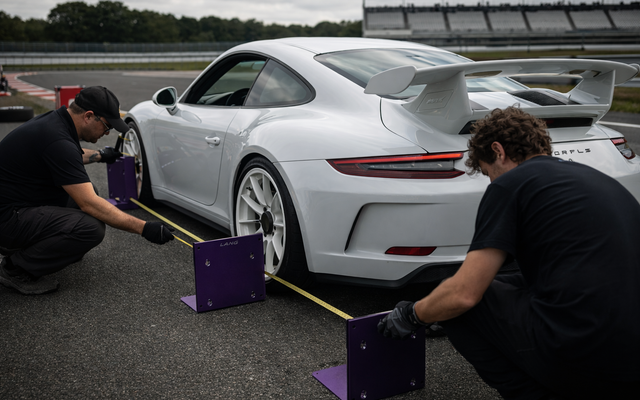
Once the fundamental hardware is in place, the next vital stage in the build is the detailed tuning of the chassis's alignment. This is the world of chassis dynamics adjustment, a methodology that can appear overwhelmingly complex to the beginner but is, in fact, the defining factor to turning a set of high-performance parts into a harmonious and controllable vehicle. The most debated parameter of tuning for oversteer is undoubtedly negative camber. Camber angle is the tilt of the tire in relation to the upright axis when observed from the front of the chassis. When the top edge of the wheel is angled towards the chassis, this is known as camber-in. In drifting, an inward tilt on the front axle tires is universally used and is seen as essential. The reason is fundamentally linked to physics.
When a car is going around a bend at extreme slip angles, the chassis tilts toward the external of the turn. This chassis roll makes the outside front tire to lose its optimal contact patch with the track surface. By adding negative camber, the wheel is pre-leaned to compensate for this tilt. As the vehicle tilts into the bend, the tire flattens out with the road surface, maximizing its traction at the precise point when it is absolutely essential for directional command. Usually, front adjustments for a serious drift car fall between approximately -3 degrees to as extreme as -5 degrees or even more, based on the specifics of the vehicle configuration, compound selection, and operator style. The back wheels also employ inward tilt, but the values are typically more modest and subtler than the front axle. Excessive inward lean at the back can cause the vehicle to extremely loose and hard to control on throttle input, as it reduces the available contact patch of the powered tires during linear power delivery. Thus, rear axle camber settings are frequently in the vicinity of -1 degree to -3 degrees, finding a precise balance between offering adequate cornering bite to aid in starting and sustaining the drift while still maintaining usable traction for acceleration the turn. camber angle is merely one element of the broader tuning puzzle, which also includes toe setting, caster angle, and bump steer modification.
Toe refers to the angle of the tires as seen from the top. Toe-in means the leading edges of the tires are nearer together than the rear edges, while outward toe means the reverse. For sliding, a slight amount of front toe-out is commonly used to improve the turn-in directional response, making the chassis feel more agile and willing to begin a drift. Rear axle toe is generally set to neutral or a very small amount of positive toe to encourage straight-line stability under acceleration. Caster is the longitudinal or rearward angle of the suspension pivot when looked at from the lateral of the chassis. More caster angle enhances feedback and high-velocity stability, and it also increases negative camber increase during steering, which is very advantageous. Adjusting these values is a detailed interplay where a change to one parameter can and often will affect the remaining parameters. The old-school approach for dialing in a chassis's alignment for drifting has for a long time been a time-consuming affair of guesswork and adjustment. A pilot or crew would make a change based on experience, test the car on track, depend on the operator's subjective perception and comments, and then apply an additional change. This loop would iterate time after time until the car felt "acceptable" or the scheduled practice session was exhausted. This system is not only extremely wasteful in terms of hours and resources, but it is additionally fundamentally inaccurate.
Pilot perception is a notoriously inconsistent metric, affected by numerous elements such as tiredness, changing track surfaces, ambient heat, and just the mindset of the pilot on that specific day. What feels "loose" on one run might feel "understeery" on the following pass, resulting in confusing data and ineffective adjustments. This traditional challenge in vehicle dynamics optimization is specifically where state-of-the-art technology has made its mark to completely change the methodology.
The advent and integration of specialized drift telemetry software has ushered in a new era for engineering and refining competitive drift cars. These tools, exemplified by innovative solutions like data acquisition tools, operate by physically capturing the real-time mechanical behavior of the vehicle as it is being driven on the course. As opposed to using personal feel, these tools acquire measurable information on key parameters such as suspension travel, wheel speed, lateral and longitudinal g-forces, lock position, and accelerator and brake pedal application. This raw telemetry is then analyzed by powerful applications that can graph and interpret the metrics in a clear format. For the very first time, engineers and teams can visualize precisely what the car is exhibiting at any given millisecond of a slide. This capability revolutionizes the whole alignment optimization process. Imagine the particular challenge of setting the front axle camber for a specific car. Instead of making a modification from -3 degrees to -3.5 degrees and then testing many laps to try and "sense" a improvement, a telemetry system can provide instant and irrefutable data. The application can show visually how the suspension's contact patch is performing during the critical phases of a slide: initiation, sustain, and changing direction. It car alignment tuning can demonstrate if the existing angle is permitting the steering tire to achieve optimal contact or if the rubber is working inefficiently on its outer edge.
The tool can after analysis suggest data-driven suggestions for adjustment. Perhaps the data reveals that the tire is still stressing its sidewall at -3.5 degrees of negative camber, suggesting that even more inward lean, say -4 degrees, might be warranted. Conversely, the data might indicate that the tread is failing to achieving temperature or that the inner edge is degrading unevenly, which could suggest that there is too much negative camber and a slight reduction back to -3.2 degrees would be more ideal. This standard of granularity and practical insight was simply impossible in the time of pure mechanical tuning.
The effect of using a advanced drift telemetry system reaches much further than only setting alignment. It serves as an priceless suspension tuning guide that is customized to your specific vehicle. When adjusting the damping settings on your coilovers, instead of relying on general guidelines or replicating another team's setup, you can use the software to analyze how the car is behaving in response to your tweaks. The application can graph the damper movement path over a lap, revealing if the coilovers are managing the weight transfer optimally or if they are allowing the car to become unsettled excessively after a transition. It can assist in identifying challenges like bottoming out or excessive extension, permitting you to make data-backed choices to helper springs, damping values, or ground clearance. This process extends equally to the intricate process of suspension geometry optimization. Beyond camber, the tool can provide insight into how modifications to toe and caster are impacting the vehicle's handling during various parts of a lap. For example, it can assist you to ascertain the ideal amount of front axle negative toe for your individual angle kit setup and piloting style by measuring the speed of initial reaction and vehicle dynamics tool the predictability of the car at full steering angle. This turns the tool an incredibly effective performance optimization handbook that is actively calibrated by the actual dynamics of your specific chassis on the track. It shifts the whole endeavor from a dark art into a repeatable optimization exercise.
Furthermore, the value of a tool like GripDial is in no way limited to expert engineers with extensive budgets. For the grassroots driver, it acts as an powerful force multiplier. It practically provides the builder with the knowledge of a professional race engineer without the associated overhead. It accelerates the tuning process by delivering suspension engineering clear directions to problems that would otherwise take countless track days of trial and error to solve. A tuner can learn how their specific vehicle behaves to various inputs, gaining a deeper comprehension of suspension theory in the endeavor. It furthermore makes accessible advanced performance tuning concepts, permitting all drivers with the drive to optimize their machine to accomplish it in a structured and effective manner. This is especially significant in a discipline like sliding, where setup expertise has historically been a closely guarded advantage among professional drivers. Now, that knowledge can be in the toolkit of every serious driver.
In conclusion, the journey to building and tuning the perfect championship-contending drift car is a multi-stage mission that smoothly integrates proven hardware principles with 21st-century data technology. It commences with the wise selection of a legendary car, then built upon the integration of essential competition parts like high-performance steering angle kits and expertly specified performance coilovers. The journey then progresses into the precision realm of chassis dynamics adjustment, where parameters like negative camber, toe setting, and caster angle are meticulously set to complement the chassis's upgraded hardware and the driver's individual style. Finally, and what truly separates the modern approach from the traditional methods, is the use of a powerful suspension tuning application. This platform eradicates the approximation and trial and error of purely subjective adjustment by giving quantifiable, real-time telemetry on how the chassis is actually behaving. It functions as an incredible engineering partner, a comprehensive alignment optimization handbook, and a all-in-one vehicle dynamics tool. In unison, this integrated approach leads to that every component of the drift machine—from the pick of the chassis to the most minute adjustment on the damper—is refined for maximum success on the track. It embodies the complete progression of the discipline of oversteer driving, merging mechanical car control with data-informed chassis dynamics to create the ultimate effective cars attainable.